


As we move into 2026, the stakes have never been higher. If your business handles Federal Contract Information (FCI) or Controlled Unclassified Information (CUI), understanding the current landscape is critical to maintaining your eligibility for DoD contracts.
What is CMMC?
CMMC is the DoD’s framework for ensuring that contractors and subcontractors across the Defense Industrial Base (DIB) have adequate cybersecurity controls in place to protect sensitive government information. Specifically, CMMC governs the protection of two categories of data:
Federal Contract Information (FCI): Information not intended for public release that is provided by or generated for the government under a contract.
Controlled Unclassified Information (CUI): Sensitive but unclassified information that requires safeguarding under law, regulation, or government-wide policy.
CMMC 2.0, the current iteration of the framework, was developed to streamline the original five-level model into a more practical three-level structure, aligning it with established NIST cybersecurity standards. Cyber threats targeting the defense supply chain cost the sector an estimated billions of dollars annually, CMMC is the DoD’s direct response to that reality.
The Three Levels of CMMC 2.0
Your required certification level depends on the type of information your organization handles and your role in the defense supply chain:
Level | Name | Key Requirement | Assessment |
Level 1 | Foundational | 15 practices | Annual Self-Assessment |
Level 2 | Advanced | 110 practices (NIST SP 800-171) | Certified Third-Party Assessment Organization (C3PAO) assessment (audit) |
Level 3 | Expert | 134 practices (NIST SP 800-172) | Government-led Defense Industrial Base Cybersecurity Assessment Center (DIBCAC) |
Most organizations that handle CUI will fall under Level 2, which requires implementation of all 110 practices mapped to NIST SP 800-171 Revision 2. Level 3 is reserved for the most critical defense programs and requires an additional 24 controls from NIST SP 800-172.
The 2026 Compliance Landscape: Phase 1 & 2
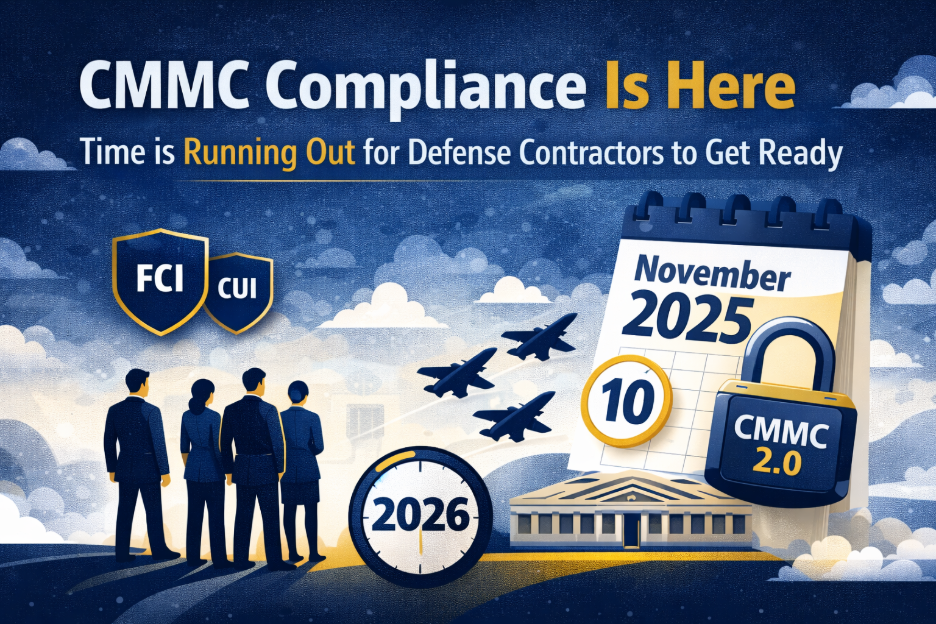
The DoD is implementing CMMC in a four-phase approach. Currently, we are in the heart of Phase 1, which runs until November 9, 2026.
Current Reality: Level 1 and Level 2 self-assessments are now appearing in new solicitations. A senior official in your company must now sign an affirmation in the Supplier Performance Risk System (SPRS), carrying legal accountability for the accuracy of your security posture.
The Upcoming Shift: Starting November 10, 2026, Phase 2 begins. This introduces mandatory C3PAO Certification for Level 2 contracts. Given that readiness for a Level 2 audit can take 6–12 months, organizations starting now are already against the clock.
Key Requirements Under CMMC 2.0
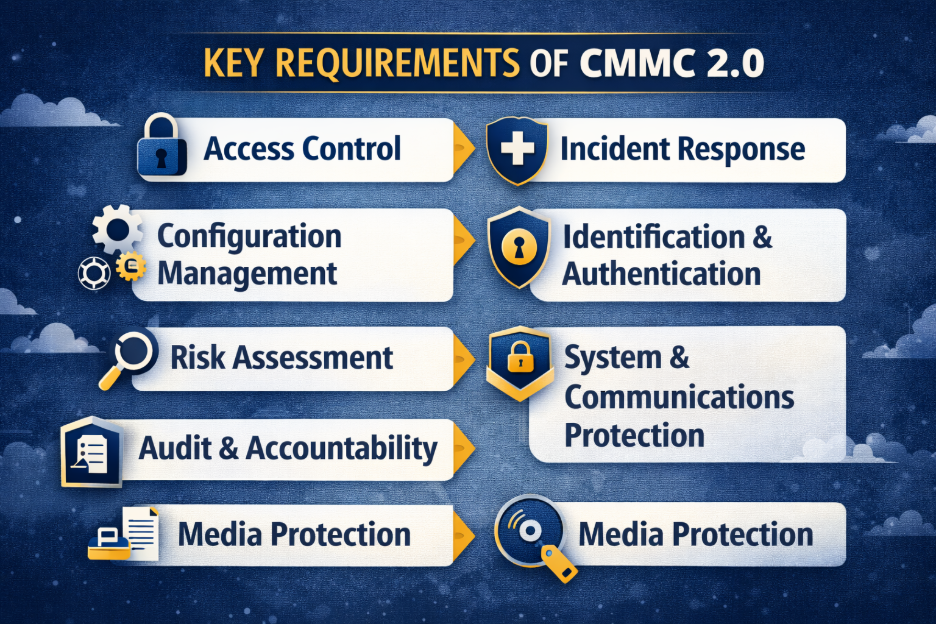
Across all levels, CMMC 2.0 is built around 14 control domains. Understanding these domains is essential to scoping your compliance program:
Access Control: Role-based permissions, multi-factor authentication, and least-privilege enforcement.
Incident Response: Documented procedures for detecting, reporting, and recovering from security incidents.
Configuration Management: Baseline configurations for all systems processing CUI or FCI.
Identification & Authentication: Strong identity verification and credential management practices.
Risk Assessment: Regular identification, evaluation, and treatment of cybersecurity risks.
System & Communications Protection: Encryption of data in transit across internal and external channels.
Audit & Accountability: Logging, monitoring, and retention of system activity records.
Media Protection: Controls over physical and digital media containing sensitive information.
For Level 2 and above, organizations must also maintain a current record in the DoD Supplier Performance Risk System (SPRS) and have their required CMMC level validated at the time of contract award. External service providers who store, transmit, or process CUI are considered in-scope even if they are not required to be CMMC-certified themselves.
Common Pitfalls Defense Contractors Face
Based on Kinverg’s experience supporting over 200 clients and 10,000+ consulting hours across compliance engagements, these are the most frequent stumbling blocks organizations encounter on the path to CMMC compliance:
Underestimating Scope: Many organizations discover mid-assessment that CUI flows through more systems, vendors, and processes than initially identified.
Inadequate Documentation: CMMC assessments are evidence-driven. Organizations accustomed to informal or verbal processes must create comprehensive written documentation of every security practice.
Supply Chain Blind Spots: Certification requirements flow down to subcontractors. Failing to verify that your supply chain partners meet appropriate CMMC levels puts your prime contractor relationships at risk.
POA&M Mismanagement: A Plan of Action & Milestones (POA&M) can be used to address open gaps at award, but it must be specific, credible, and backed by a timeline. Vague remediation plans will not pass scrutiny.
Outdated Systems: Many organizations run legacy systems that cannot easily implement modern security controls. These must either be isolated, upgraded, or covered with compensating controls, all of which require planning.
Cloud and Third-Party Risk: Cloud service providers and external service providers in scope must meet FedRAMP Moderate or equivalent standards. This is frequently overlooked.
CMMC and NIST SP 800-171: The Core Connection
CMMC 2.0 Level 2 is essentially a verified implementation of NIST SP 800-171 Revision 2. If your organization has been subject to Defense Federal Acquisition Regulation Supplement (DFARS) 252.204-7012, you are already obligated to implement NIST 800-171 controls, but CMMC now requires you to prove it through assessment rather than self-attestation alone.
For Level 2 contractors, this means your Supplier Performance Risk System (SPRS) score must accurately reflect your current compliance postureand starting in November 2026, a Certified Third-Party Assessment Organization (C3PAO) will independently verify your controls. Annual affirmations by a senior executive are also required, making compliance a matter of executive accountability, not just a technical checkbox.
How Kinverg Can Help You Achieve and Maintain CMMC Compliance
Navigating CMMC compliance is comple, but you do not have to do it alone. Kinverg has helped various US based organizations achieve CMMC compliance, with deep expertise across NIST 800-171, NIST 800-172, etc.
Our CMMC Consulting Services Include:
Gap Assessment & Readiness Review: We evaluate your current security posture against CMMC Level 1, 2, or 3 requirements and produce a detailed gap analysis with prioritized remediation steps.
NIST SP 800-171 Implementation Support: Our consultants guide your team through implementing all required controls, from access management and encryption to incident response and audit logging.
SPRS Score Optimization: We help you accurately calculate and document your SPRS score, so it reflects your true compliance posture and holds up under scrutiny.
Plan of Action and Milestones (POA&M) Development: Where gaps exist, we help you build a credible, board-ready POA&M that satisfies DoD expectations.
Certified Third Party Assessment Organization (C3PAO) Assessment Preparation: We prepare your organization for third-party assessment, including evidence collection, documentation review, and mock assessments.
Ongoing Compliance Monitoring & Annual Affirmation Support: Compliance is not a one-time event therefore, we support your continuous compliance posture and annual executive affirmation obligations.
Supply Chain & Subcontractor Guidance: We help prime contractors assess and guide their subcontractor ecosystem to ensure flow-down requirements are met.
Automate Your CMMC Compliance with Compliance Machine
Beyond consulting, Kinverg offers ComplianceMachine.AI, our award-winning compliance automation platform that has earned the prestigious Pakistan Innovation Award. Compliance Machine transforms the traditionally manual, spreadsheet-heavy compliance process into a streamlined, intelligent workflow.
Key Features of Compliance Machine for CMMC:
Multi-Framework Support: Simultaneously manage CMMC alongside SOC 2, ISO 27001, HIPAA, GDPR, CMMI, ISO 27701, and many more, from a single platform.
Compliance Machine Control Library (CLIB™): A built-in control library spanning AI, Cloud, Cybersecurity, and Data Privacy domains, pre-mapped to CMMC requirements so you’re never starting from scratch.
Audit-Ready Policies: Pre-written, customizable policies aligned with CMMC and NIST 800-171 requirements, ready for evidence submission from day one.
Real-Time Compliance Monitoring: Continuously track your compliance posture and get instant alerts on control gaps or drift, so you stay audit-ready year-round, not just at assessment time.
Automated Reporting: Generate assessment-ready reports, SPRS scoring documentation, and leadership dashboards with a click, eliminating hours of manual compilation.
Actionable KPIs and KRIs: Leadership-facing dashboards surface the metrics that matter, enabling smarter decisions and proactive risk management.
Regional Regulation Support: Compliance Machine covers regional requirements across the US, EU, UAE, Saudi Arabia, Pakistan, and beyond, ideal for organizations with global footprints.
Whether you are beginning your CMMC journey, preparing for a C3PAO assessment, or seeking to maintain continuous compliance without burdening your internal team, Compliance Machine gives you the automation infrastructure to do it efficiently and confidently.